


our commitments
MANIFESTO
At A.P.C., we believe that creating, producing, and passing knowledge and craft on only make sense if we remain true to our commitments to the planet, our teams, and society.
The Atelier, Production and Creation embody the collective spirit, high standards and simplicity that have guided the brand from the very beginning, creating garments designed to stand the test of time and transcend ever-changing trends. From early on, A.P.C. embraced this philosophy of longevity and circularity dear to its founder, offering second-hand pieces and repurpposing its deadstock fabric.
In 2023, we chose to go further by setting science-based decarbonization targets and embedding eco-design principles into our work. Our responsibility extends beyond the impact of our products. It includes the people who make them, our team which we support throughout their careers, and civil society, to which we contribute through philanthropic initiatives.
We don’t have all the answers, yet we are guided by one conviction: by staying true to our values, we can play our part in building a more responsible fashion industry.
Read the CSR Report – December 2025
A LONG-STANDING COMMITMENT…
-EXTENDING THE LIFE OF OUR PIECES
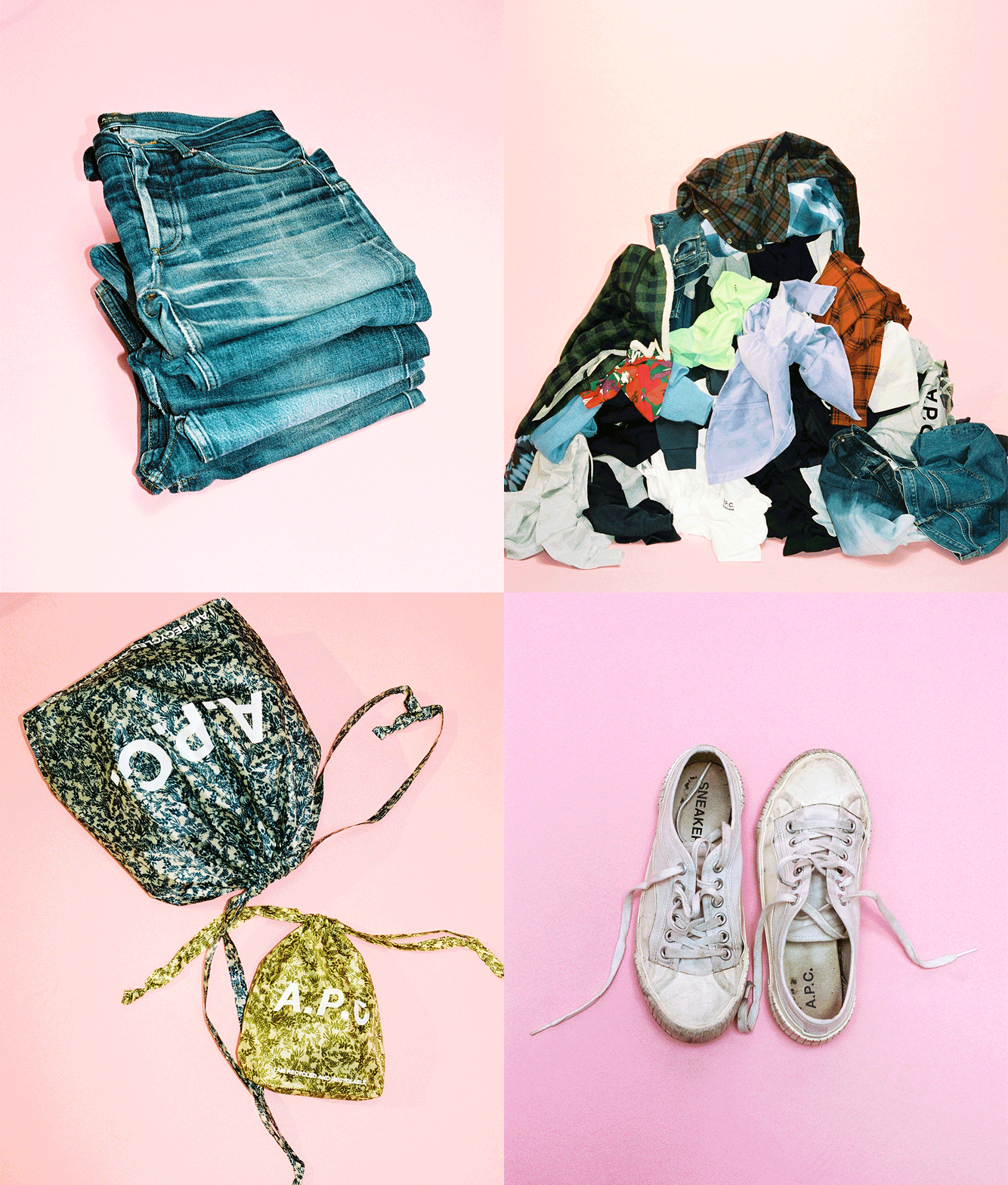
In 2008, to extend the life of its iconic raw denim, A.P.C. launched the Butler program. Customers can bring back their old A.P.C. jeans to receive a new pair at half price. The natural patina of each jean tells the story of its previous owner, who signs the inside pocket. After being carefully washed, repaired, and pressed inside-out, the jeans return to the store shelves, ready to begin a new chapter as a true vintage piece.
Building on this program, A.P.C. also offers clients the option to return old A.P.C. items in exchange for a store credit. Depending on their condition, the pieces are resold at the A.P.C. Vintage boutique or donated to charity.
-UPCYCLING OUR DEADSTOCK FABRIC
Since 2010, Jessica Ogden, a designer passionate about patchwork, has been reworking surplus fabrics from past A.P.C. collections to create exclusive quilt series. Each piece is entirely hand-stitched by artisans specialized in patchwork from the Bangalore region of India.
-REDUCING PACKAGING & SUPPORTING GOODPLANET
To limit in-store packaging, A.P.C. encourages clients to bring their own bags when shopping.
Since 2019, the distribution of single-use packaging has been replaced by the possibility for customers to buy a reusable bag for 3€ made from recycled materials (rPET 190T). Just like A.P.C. sneakers, this bag can be returned to the store to be recycled by The 8 Impact and repurposed in various applications, including sneakers and bike lanes.
For every bag sold, €1 is donated to GoodPlanet, an organization founded in 2005 by Yann Arthus-Bertrand and recognized as serving the public interest. It leads environmental and solidarity projects worldwide, notably through its Action Carbone Solidaire program. In 2024, A.P.C.’s support helped complete a solidarity project in boarding schools in Ladakh. Since 2025, funds have supported a biodiversity restoration project in the Drôme region.
…STRENGTHENED IN 2023 WITH CLEAR TARGETS
-REDUCING OUR CARBON FOOTPRINT IN LINE WITH THE PARIS AGREEMENT
The 2015 Paris Agreement is the first worldwide effort to limit global warming, aiming to keep temperature rise well below 2°C, and ideally to 1.5°C, compared with pre-industrial levels, to keep our planet livable.
In 2023, A.P.C. committed to reducing its CO₂e emissions in alignment with this Agreement.
Our decarbonization targets have been validated by the Science Based Targets initiative (SBTi), an international body ensuring scientific rigor in emissions-reduction pathways. To monitor progress, A.P.C. calculates its carbon footprint® with Carbonfact, following the Greenhouse Gas Protocol, the international reference standard for carbon accounting.
- Scope 1 and 2 emissions, which are linked to our energy consumption, represent 1% of our carbon footprint®. Thanks to the switch to renewable electricity in more than half of our facilities worldwide, these emissions fell by 43% in absolute terms between 2022 and 2024. Though we have already met our final target, we remain committed to our efforts.
- Scope 3 emissions are those indirectly generated throughout our value chain and account for 99% of our footprint. In 2024, driven notably by our growing use of recycled and organic materials, we reduced them by 31% in monetary intensity compared with 2022.
Those results are audited and certified by Deloitte.
-ECO-DESIGNING OUR PRODUCTS
We have always prioritized natural materials like cotton, wool and leather, carefully selected for their quality, to create pieces that last.
In 2023, we established our definition of a “responsible product” in order to value materials with a reduced impact on the planet, workers’ well-being and animal welfare,
In 2025, we committed to ensuring that 70% of our products would meet this standard by 2027.
GOTS CERTIFICATION

For many years, A.P.C. has been working with GOTS-certified suppliers (Global Organic Textile Standard), one of the most internationally recognized standards for its high requirements and traceability of organic textiles.
In 2023, thanks to the dedication of its team, A.P.C. reached a new milestone by obtaining its own GOTS certification from Ecocert Greenlife (License No. 214416). Every year, an audit ensures that our practices comply with the standard’s requirements: meticulous documentation of every step, separate management of certified product flows, laboratory compliance testing, social and environmental policies.
In 2025, 63% of our jersey products (t-shirts, sweatshirts, dresses, etc.) are GOTS-certified. Made from at least 95% organic fibers, these products come from a fully certified and traceable production chain, from the cotton field to the finished item. Every step follows strict criteria, including the absence of GMOs and harmful substances, responsible management of water and waste, and fair and safe working conditions.
OUR LEATHER

A.P.C. is a member of the Leather Working Group (LWG), which brings together NGOs, brands, manufacturers, and tanneries to promote best practices across the leather industry.
To be LWG certified, a tannery must meet stringent criteria governing water, chemicals, waste, and energy management. In 2025, for 98% of products where leather is the primary material, the leather comes from an LWG-certified tannery.
Since 2023, A.P.C. has banned raw hides originating from South America or of unknown origin to ensure none come from farms located in illegally deforested or high-risk areas.
OUR DENIM
A hallmark of A.P.C., raw denim jeans are renowned for the durability of their 100% cotton fabric. After weaving, the material undergoes no washing or artificial finishing—two processes typically heavy in water, energy and chemicals.
In 2025, one-third of our denim models were made from raw denim.
For the rest of our jeans, we work with suppliers who minimize their impact through closed-loop water recycling, participation in the Zero Discharge of Hazardous Chemicals program, the use of renewable electricity, air-drying methods, and B Corp certification.
- AUDITING OUR SUPPLIERS
OUR DIRECT SUPPLIERS
In 2024, 76% of our tier-1 (direct) suppliers were located in near-shore regions, primarily in Portugal, Morocco, and Tunisia.
By signing our Code of Conduct, they commit to respecting our social requirements, aligned with the International Labour Organization’s fundamental principles and rights: prohibition of child labor, forced labor, corruption, and discrimination; respect for labor laws and freedom of association; and guaranteed safe working conditions.
A.P.C. ensures compliance through social audits conducted by independent auditors against rigorous standards such as BSCI, WCA, SMETA, ICS, GOTS, or SA8000.
We had aimed for 70% of our direct suppliers (by purchasing value) to have a valid audit in 2024. This goal was exceeded, with 85% audited, a result certified by Deloitte.
TRACEABILITY OF OUR SUPPLY CHAIN
Since 2023, we have partnered with Fairly Made to trace our full production chain, from raw material to finished product. This traceability work is essential for strengthening our oversight of environmental and social impacts and improving product transparency.
By scanning the QR code on a product tag or online, customers can access:
- the countries and certifications of suppliers across the production chain,
- the distance traveled,
- its recyclability rate and traceability score.
…AND A SPECIAL FOCUS ON OUR EMPLOYEES
GENDER EQUALITY
In 2024, our gender equality index was 80/100. We are proud to have a majority of women across our teams, including in leadership roles.
INCLUSION & DIVERSITY
A.P.C. supports its employees at every stage of their professional life.
During maternity and paternity leave, salaries are maintained at 100%. To ease the return to work, employees receive financial assistance in the form of CESU vouchers.
Employees approaching retirement receive training, in partnership with the Fertiles association, to help prepare for this key transition.
Every team member can benefit from three sessions with an occupational psychologist, covered by A.P.C., to help prevent psychosocial risks.
TRAINING
In addition to sessions of cross-training, department-specific and safety training, A.P.C. places special emphasis on CSR:
- Ongoing eco-design training for operational teams since 2022,
- CSR as a core pillar of the Talents program, an initiative launched in 2025 by the Executive Board to prepare A.P.C.’s future leaders for tomorrow’s responsibilities through mentoring, training and strategic insights,
- “2tonnes” workshops open to all to explore how individual and collective actions can help address climate change.