


A.P.C. jean
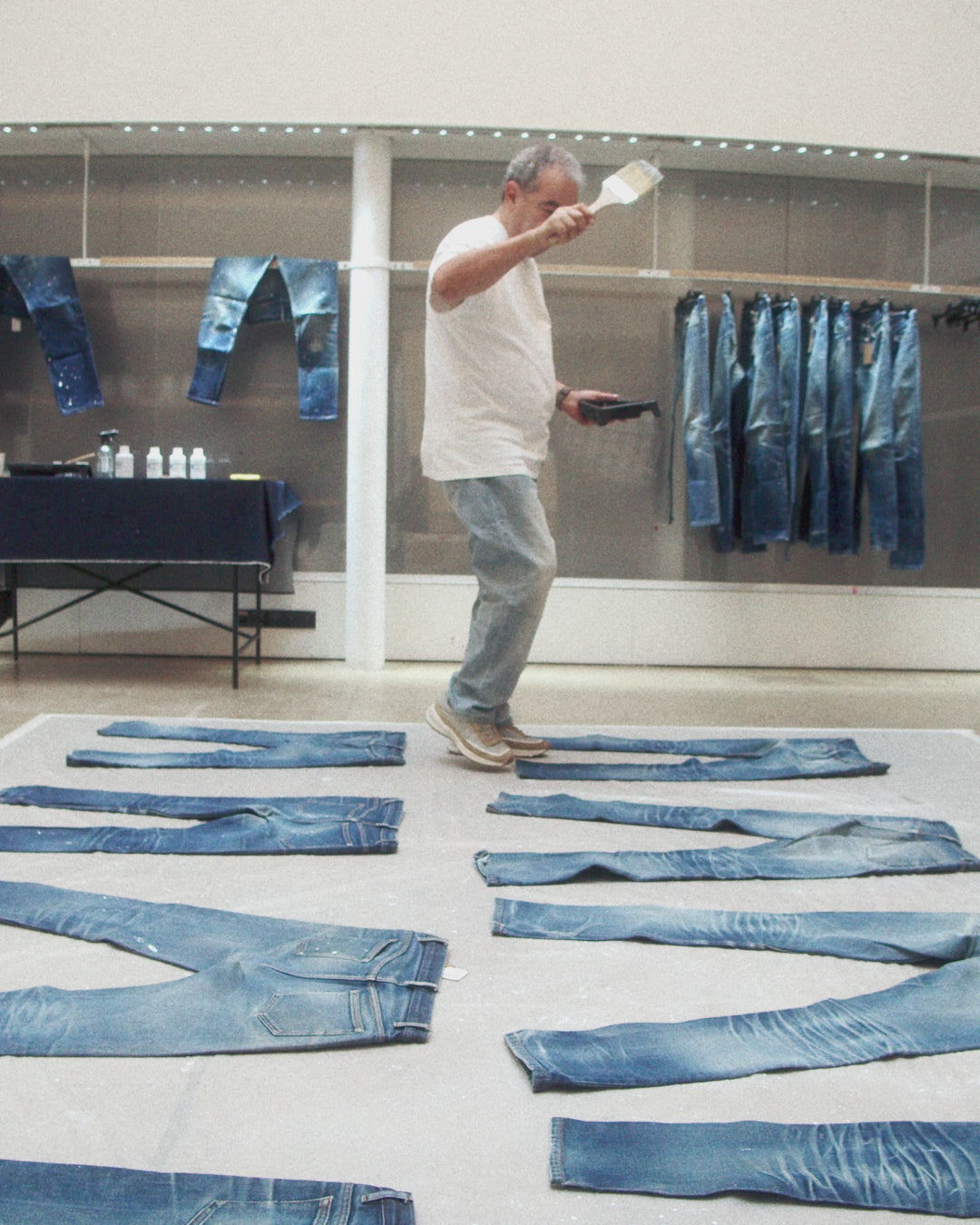
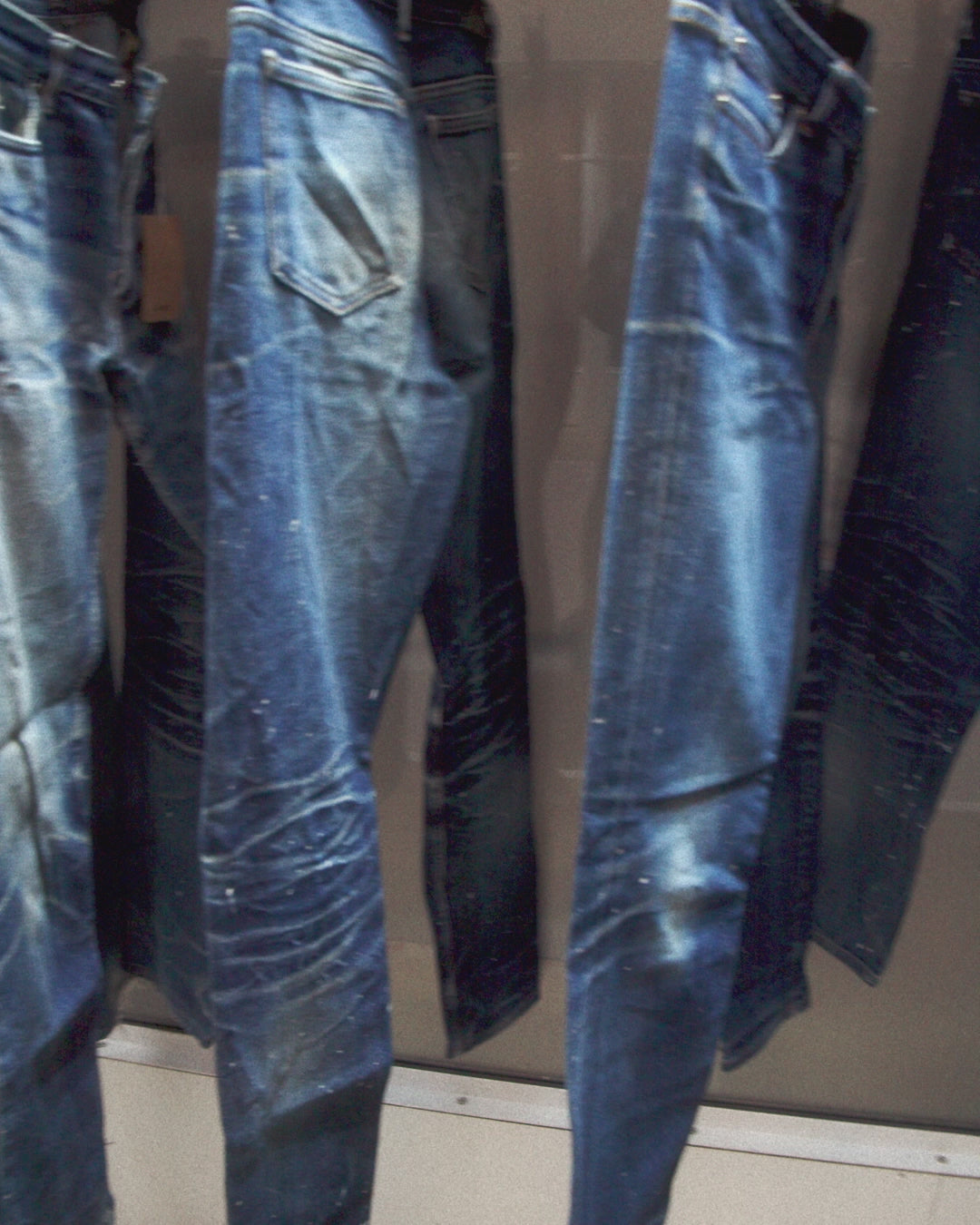
Every A.P.C. jean is cut from a Japanese fabric developed exclusively for the brand — a 14.5 oz twill woven on vintage 27-inch shuttle looms, whose slight irregularities give it its character. Raw, untreated, indigo-dyed, A.P.C. denim asserts itself over time: where the fabric rubs, the color fades; where it is protected, it stays. It is an exact reflection of the person who wears it.
The 27-inch width is that of the shuttle looms traditionally used in Japan to weave kimono fabric. This narrow width means the natural edge of the cloth runs along the outer leg seam — that's the selvedge. It's only visible when you cuff your jean. These slow looms produce a fabric with a hand and a texture that modern industrial machines simply can't replicate.
The 14.5 oz weight is a deliberate choice. Dense enough for the fabric to evolve and hold the memory of wear, without making the break-in feel like an ordeal. The yarn is single-twist. The weave is right-hand twill: the diagonal lines run from right to left, which determines how the fabric behaves on the body and adjusts to it over time.
Indigo dye deposits in successive layers around the thread without penetrating the fiber. This is what produces, through wear, contrasts that are unique to each jean. The more layers, the more pronounced the variation. All A.P.C. fabrics are sanforized before cutting — a mechanical treatment that stabilizes the cloth and limits shrinkage at the first wash.
This weaver has worked with A.P.C. for over thirty years, with no signed contract. The exact finishing formula has never been shared. He refuses to sell this fabric to any other brand.
One distinguishing mark: the first button, engraved with a crossed guitar and dagger. A detail that is anything but, since 1988.
The story of A.P.C. denim, as told by Jean Touitou, here.
A text by Jean Touitou
To finance the early days of A.P.C. – and considering that I distrusted bankers but also had no personal fortune – I worked as a “ghost designer” for several brands. One was based in London, another in Toronto and a third in Paris. This last brand had major experience in denim. One day, I asked the boss of this brand for some advice about making a great pair of blue jeans and I was given a bolt of Japanese denim, which was not very wide.
I received just one indication: connect the two exterior edges with the red trim (two sketches are included to explain these seemingly mysterious yet actually very simple things). So, I sketched my design, had a pattern made and then cut and produced our first pair of jeans in the workshop of the neighborhood seamstress, who was thrilled to participate in such an adventure. However, I didn’t know – and therefore didn’t follow – a certain number of rules and codes that obsess denimheads, afficionados, nerds, specialists and all guardians of the temple. For example, the rule about cutting the waistband on the bias: since I wasn’t aware of this, I cut it straight along the grain and it’s been like that ever since.

Left: Sketch by Shinya Hirota from the A.P.C. studio
Right: Sketch by Jean Touitou
THE POSITIONING OF THE PATTERN ON THE FABRIC
This is a simple matter of construction: connecting the two edges of fabric on the outer side of the legs keeps the jean legs straight (and prevents them from twisting). I know it’s a little abstract when it’s not your job, so here are some additional explanations in the form of sketches.
NO-SELVAGE (US: selvage, UK: selvedge)
Defining jeans as “selvage” is as ridiculous as describing water as wet. In French, “selvage” means the edge, yet all fabric has two edges. Without selvage/edges, a fabric would not be usable, as it would become unwoven. But let’s be good sports: this term is now commonplace and I’m not going to revolt against a term that is rather practical. When it comes down to it, it’s easier to use the word “selvage” than to say: “jeans designed from a fabric with a red trim whose outer sides were cut along the edges.
You have to be able to accept approximations. For example, what people commonly call RnB in popular music has little to do with rhythm and even less with blues.
THE FABRICS
When I received this famous first bolt of fabric with its narrow width, I tried to find out where it came from. I was given the name of a weaver based somewhere near Hiroshima. I contacted him and, because he already knew my work thanks to the success of our first shop in Tokyo, he offered me a different version of this fabric, which would be exclusive to A.P.C. I accepted his offer. This fabric has a secret that only he and I know and that neither of us have ever shared with anyone else. More than 35 years later and without signing a contract, the weaver has kept our recipe and has always refused to sell “our” fabric to other brands.